
Jenmon | Blogs
Crane Company in Singapore: Jenmon’s Full Range of Lifting Solutions
Sep
Your crane stops mid-lift on the factory floor, or you’re at the drawing board stage of a new project, trying to work out who can design, supply and then look after a crane system for years, not just sell you one and move on.
We are Jenmon International, a crane company in Singapore since 2001. We design, supply, install, test, commission and maintain lifting equipment, and our service team takes emergency calls 24 hours a day, seven days a week. This article explains what we do, how the pieces fit together, and what to check before you sign with any crane supplier in Singapore.
Which crane company in Singapore can handle both supply and after-sales service?
Many suppliers stop once the crane is installed. We don’t. Our work runs from the first site visit through to design, supply, installation, testing, and then ongoing maintenance throughout the equipment’s working life. That full loop is what separates a crane company from a crane seller.
In one sentence: If a company can only quote you a price for the crane itself and has no answer for who maintains it in year five, that’s a gap worth asking about before you commit.
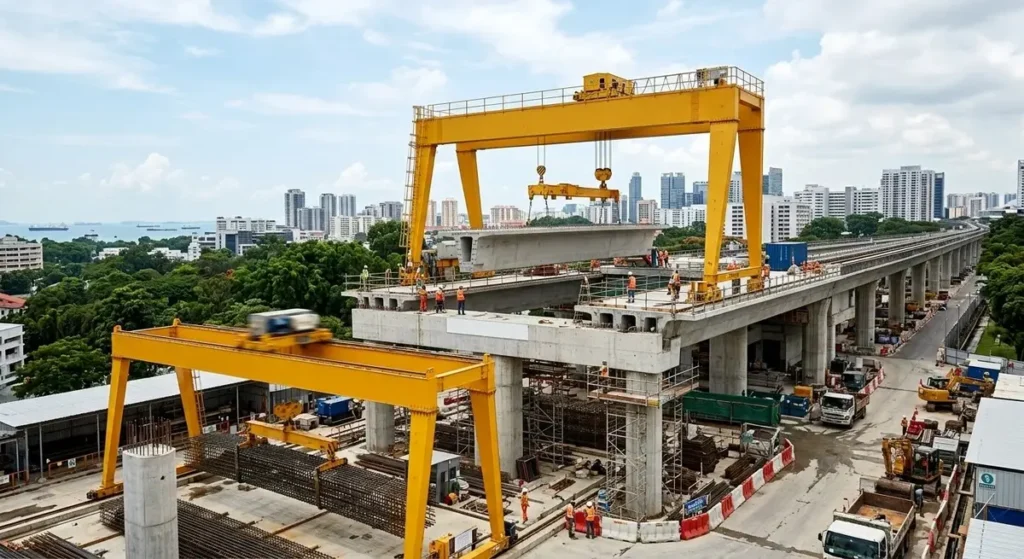
Our own full range of cranes spans engineered cranes for specialised jobs, such as deep tunnel work and power plants, right through to standard gantry, overhead, and jib cranes for everyday factory use. Our equipment is supported by an after-sales servicing team, not just a sales invoice.
Workplace safety data backs up why this matters. The Workplace Safety and Health Council recorded eight dangerous occurrence cases in 2019 caused by the collapse or failure of crane structures and equipment.
What does a crane company in Singapore actually design and supply?
Our product range covers three broad groups. Engineered cranes are designed for specific, demanding applications, including deep tunnelling, waste-to-energy plants, and MRT depot projects. Standard cranes cover the day-to-day needs of factories and warehouses, including gantry cranes, overhead cranes, and jib cranes. Hoists and winches are lifting components used across these crane systems.
One example is our Verlinde EUROBLOC VT wire rope hoist range, which covers loads from 800 kg up to 80,000 kg. That means the heaviest hoist in that line lifts a hundred times more than the lightest one, all within a single product family. We also supply lifting accessories such as webbing slings, shackles, and spreader beams, so a site can source the crane and the gear that goes with it from one supplier.
Here’s how the main service types break down:
| Service | What it covers | Best suited for |
| Design & Installation | Site assessment, crane design, supply, installation | New builds, plant expansions |
| Preventive Maintenance & Inspections | Scheduled checks to catch wear before it becomes a failure | Sites running cranes daily |
| Emergency Response | 24-hour breakdown callout | Any site that can’t afford downtime |
| Spare Parts | Parts sourcing for multiple crane brands, not only ours | Facilities with mixed equipment |
| Training | On-site courses for operators | New crane operators, refresher training |
How do you know a crane supplier in Singapore meets safety and quality standards?
We’re registered with the Building and Construction Authority under workheads including mechanical engineering and mechanical equipment, and we hold bizSAFE and ISO 9001 certification. You can see the details on our qualifications and safety policy page.
These aren’t just marketing claims. BCA registration and bizSAFE certification show that a supplier meets relevant requirements, while ISO 9001 outlines a documented quality management system subject to audits. If a supplier can’t point to something similar, that’s worth asking directly, not assuming.
Singapore also has a specific technical standard for this type of equipment: SS 497:2011, the Code of Practice for the Design, Safe Use and Maintenance of Gantry Cranes, Overhead Travelling Cranes, Jib Cranes and Monorail Hoists. The Workplace Safety and Health Council references it, and it sits alongside the wider WSH regulatory framework. A crane company operating in Singapore should be able to speak to this standard without hesitation.
What happens after the crane is installed?
This is where many relationships with crane suppliers break down. Installation is a one-off event. Maintenance is not.
We run scheduled preventive maintenance and inspections, supported by our Electronic Servicing Operation System (eSOS) to track service history. If something fails outside of a scheduled visit, our emergency response service covers breakdowns around the clock. We also provide spare parts for multiple crane brands, not just our own equipment, and offer motor rewinding, dismantling and relocation, and modernisation work for older systems that need upgrading rather than full replacement.
Training matters here too. A well-maintained crane operated incorrectly is still a risk. We run on-site operator training programmes, covering everything from safe operation to maintenance and troubleshooting.
One thing worth saying plainly: we don’t publish prices for cranes or servicing on our website. Every job depends on load capacity, span, site access, and existing equipment, so we can only provide a fair quote after we’ve reviewed the requirements. That’s not a lack of transparency. It’s just how project-based lifting equipment gets priced.
If you’re weighing up a new crane system or trying to get an ageing one properly assessed, send us an enquiry, and our consultants will walk through your site requirements with you.
Frequently asked questions
Does Jenmon only work with large companies or big infrastructure projects?
No. We supply everything from single-workstation jib cranes for small workshops to large-scale engineered cranes for infrastructure projects, so the scale of the enquiry doesn’t need to match a major construction job.
Can Jenmon service a crane it didn’t originally supply?
Yes. Our spare parts service specifically covers multiple crane brands, and our maintenance and inspection services support existing crane installations.
How fast can Jenmon respond to a breakdown?
We aim to respond within 4 hours of your call, and our emergency line operates 24 hours a day, seven days a week, including outside normal business hours, since crane failures rarely happen on a convenient schedule.
Do I need to buy a new crane, or can an old one be upgraded?
Often it can be upgraded. Our modernisation and modification service is built for exactly this, extending the working life of existing equipment rather than defaulting straight to replacement.
How do I get a quote?
You can send your site details and requirements through our enquiry page, and a consultant will follow up to discuss load capacity, site conditions, and the right equipment for the job.
