
Jenmon | Blogs
Overhead Crane Parts and Components: A Buyer’s Guide
Sep
Your maintenance team has told you a part needs replacing, and you’re trying to decide whether to order the exact original component or accept a generic substitute to save time.
At Jenmon, we supply both mechanical and electrical components for overhead cranes, plus spare parts across multiple crane brands, not only our own equipment. This guide covers what parts matter most, when a generic substitute is acceptable, and when it isn’t.
What overhead crane parts should I keep on hand for my facility?
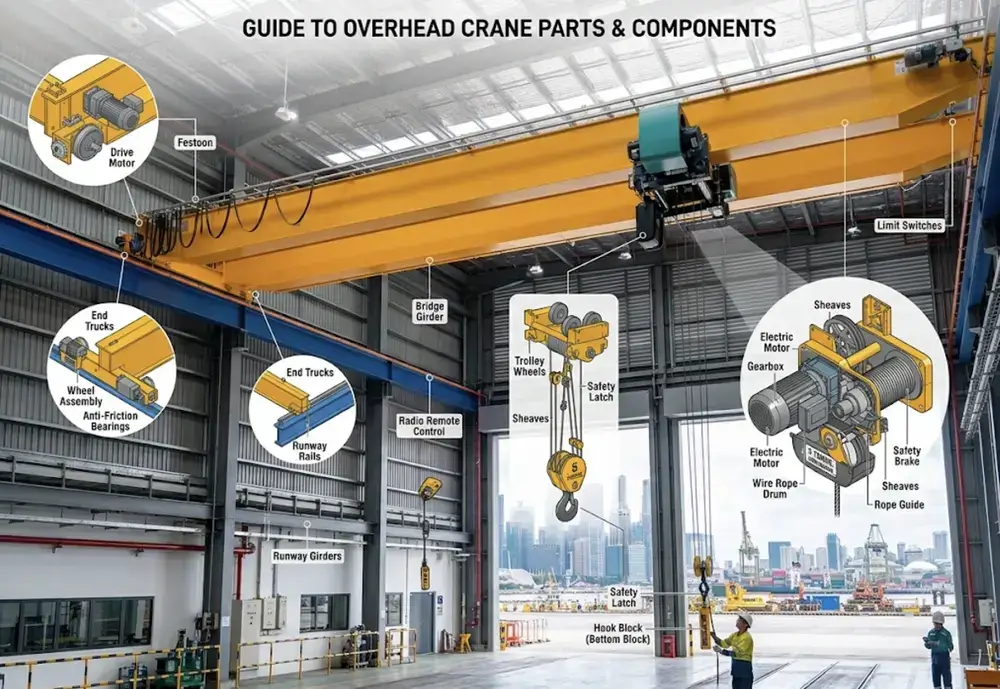
It depends on your crane’s duty cycle, but most facilities benefit from keeping basic wear items in stock rather than ordering only after a failure. That typically includes items tied to the hoist mechanism and the electrical control system, since these fail more often than the structural steelwork itself.
Wear and moving components generally require more frequent inspection and replacement than the crane’s fixed structural components.
We supply mechanical components covering gearing, brakes, and drive mechanisms, along with electrical and electronic components for control systems. For sites running equipment from several different manufacturers, our spare parts service for multiple crane brands means one supplier can cover mixed equipment, rather than chasing separate parts channels for each brand on site.
Which components fail most often, and why?
Mechanical wear parts, such as brake linings, gearing, and wire rope, can degrade through normal use and wear over time. Regular inspection makes signs of wear easier to spot before they develop into more serious problems. Electrical components, including motor windings and control contactors, tend to fail from heat cycling and electrical stress over time, which is less visible during a routine walk-past inspection.
This distinction matters for stocking decisions. A visible mechanical part can often wait for a scheduled order once you spot wear. An electrical component can fail without obvious visible wear, making it a stronger case for keeping a spare on hand, especially if a specific replacement could take days to source. To see how these issues show up on site, our guide to common overhead crane part failures covers the warning signs to watch for.
Should you always use original parts, or is a generic substitute acceptable?
For structural and safety-critical components, replacement parts should meet the crane manufacturer’s specifications and applicable safety requirements. A hook, a wire rope, or a brake assembly interacts directly with load-bearing forces, and a mismatched part can change how the whole system performs under load, not just how that one component behaves.
For some non-safety-critical items, a compatible replacement part may be suitable, provided it meets the crane manufacturer’s specifications and applicable requirements. Jenmon can help identify suitable replacement options based on your equipment and its requirements.
How do lead times usually work for parts sourcing?
This is where honesty matters more than a confident promise. Common wear parts for equipment we regularly service are usually available quickly. Less common components, particularly for older equipment or less common crane brands, can take longer to source, and we tell clients this upfront rather than giving an optimistic estimate that slips. Planning ahead, rather than ordering only once a part has already failed, is the single biggest factor in avoiding extended downtime.
If you need to source parts for an upcoming maintenance cycle, or want to review what to keep in stock for your specific equipment, send us an enquiry, and we’ll go through your crane’s setup with you.
Frequently asked questions
Can you source parts for a crane brand you didn’t originally supply?
Yes, our spare parts service covers multiple crane brands, so the original supplier doesn’t need to be us for our team to help source replacement parts.
Is it cheaper to buy parts in bulk ahead of time?
It can be for consistently used wear items, since ordering ahead may help avoid the higher costs and delays associated with urgent single-part orders, though this only makes sense for parts with a known, predictable replacement pattern.
How do I know if a part failure points to a bigger problem?
Repeated failure of the same component within a short timeframe usually signals an underlying issue elsewhere in the system, such as misalignment or overloading, rather than the part itself simply being defective.
Do you help identify which part has actually failed if we’re not sure?
Yes, our engineers can assess the equipment and diagnose the specific failed component, which is often more reliable than guessing based on symptoms alone before ordering a replacement.
