
Jenmon | Blogs
Lifting Equipment Guide: Wire Rope Hoist or Electric Chain Hoist?
Nov
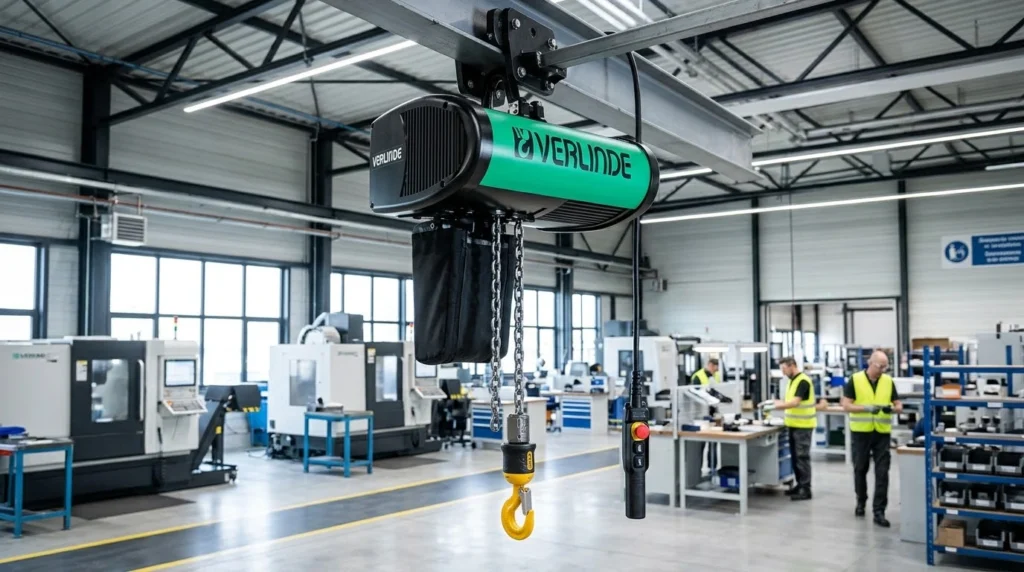
Verlinde’s EUROCHAIN VR electric chain hoists cover loads from 63 kg to 10,000 kg, while its EUROCHAIN VL models cover 60 kg to 10,000 kg. Its EUROBLOC VT electric wire rope hoists cover 800 kg to 80,000 kg. Between 800 kg and 10,000 kg, both types are available, so capacity alone doesn’t decide the choice. Duty, lift height, headroom, and the inspection routine usually do.
This guide compares the two types of lifting equipment in Singapore and sets out the examination rules that apply to hoists. It does not replace sizing for your own load and runway, which a supplier should confirm against the exact model.
What is the difference between a wire rope hoist and an electric chain hoist?
A wire rope hoist lifts with steel wire rope wound on a drum. An electric chain hoist lifts with a load chain. In general, wire rope hoists are chosen for higher capacities and heavier duty, and chain hoists for lighter loads and compact installations.
| Factor | Wire rope hoist | Electric chain hoist |
| Lifting medium | Wire rope on a drum | Load chain |
| Typical use | Higher capacity, heavier duty | Lighter loads, general handling |
| Verlinde capacity range | EUROBLOC VT: 800 kg to 80,000 kg | EUROCHAIN VR: 63 kg to 10,000 kg; EUROCHAIN VL: 60 kg to 10,000 kg |
| Wear focus | Rope condition, drum, brakes | Chain condition, hooks, brakes |
| Mounting | Standard headroom, short headroom, double girder trolley, foot or overhead mounted | Hook or bracket suspended, manual trolley or electric trolley |
How do you choose between them for your site?
Start with the heaviest load, the lift height and the number of lifts per shift, then check the headroom and the runway rating. Within Verlinde’s ranges, a chain hoist is the practical choice below 800 kg, where the wire rope range starts, and a wire rope hoist is the only choice above 10,000 kg, where the electric chain range ends. In between, compare duty cycle, headroom and inspection effort.
Singapore’s humid climate makes corrosion protection a selection point for either type, so ask how the lifting chain or rope is protected and how often it needs lubricating.
Singapore Standard SS 497:2011, referenced by the Workplace Safety and Health Council, covers the design, safe use and maintenance of overhead travelling cranes, gantry cranes and monorail hoists. Where applicable, hoist selection should follow this safe-use framework.
What does maintenance look like for each?
Both types need scheduled inspection of the lifting medium, brakes, limit devices and hooks. Wire rope hoists need rope and drum checks. Chain hoists need chain wear and lubrication checks. Neither is maintenance-free.
Singapore adds a statutory layer. MOM’s classification of lifting equipment lists a chain block as a lifting appliance (code 303) and an electric-powered hoist as an “Other Lifting Machine” (code 906) in the annex to MOM’s list of Authorised Examiners (Lifting Equipment). Under MOM circular MOM/OSHD/2025-05, Lifting Appliances and Lifting Machines are subject to periodic examination every 12 months while in use. However, the applicable testing and examination requirements depend on the equipment’s classification and circumstances. Confirm the requirements for your specific installation with an Authorised Examiner.
Swapping one type for another on an existing runway depends on the runway rating, headroom, and trolley fit. Carry out a structural assessment before installation to confirm the existing support structure can safely accommodate the new hoist.
Frequently asked questions
Is a chain hoist enough for a 5-tonne load?
It can be. Verlinde’s electric chain hoists go up to 10,000 kg, so 5 tonnes sits in the range where both types are made. Decide on duty, headroom and how much inspection effort you can support.
What should I tell a supplier about duty?
Give the number of lifts per hour or per shift, the typical and maximum load, the hours of operation per day and the lift height. A supplier uses these to match the hoist’s duty classification to the work, so “heavy use” on its own is not enough.
Where do I find the specification for a particular model?
In the manufacturer’s technical sheet for that model. Catalogue capacity ranges are a starting point; the sheet gives the dimensions and load details to check against your runway.
Sourcing a Verlinde hoist
Jenmon is the Authorised Agent of Verlinde in Singapore and lists both ranges: wire rope hoists and chain hoists. The EUROBLOC VT is covered in more detail in its own guide, and electric chain hoist applications by industry shows where chain hoists are used. The manufacturer’s data for a specific model is available through a technical sheet request.
To size a hoist, send the load, lift height and duty through Jenmon’s enquiry page and ask which type those figures point to.
